

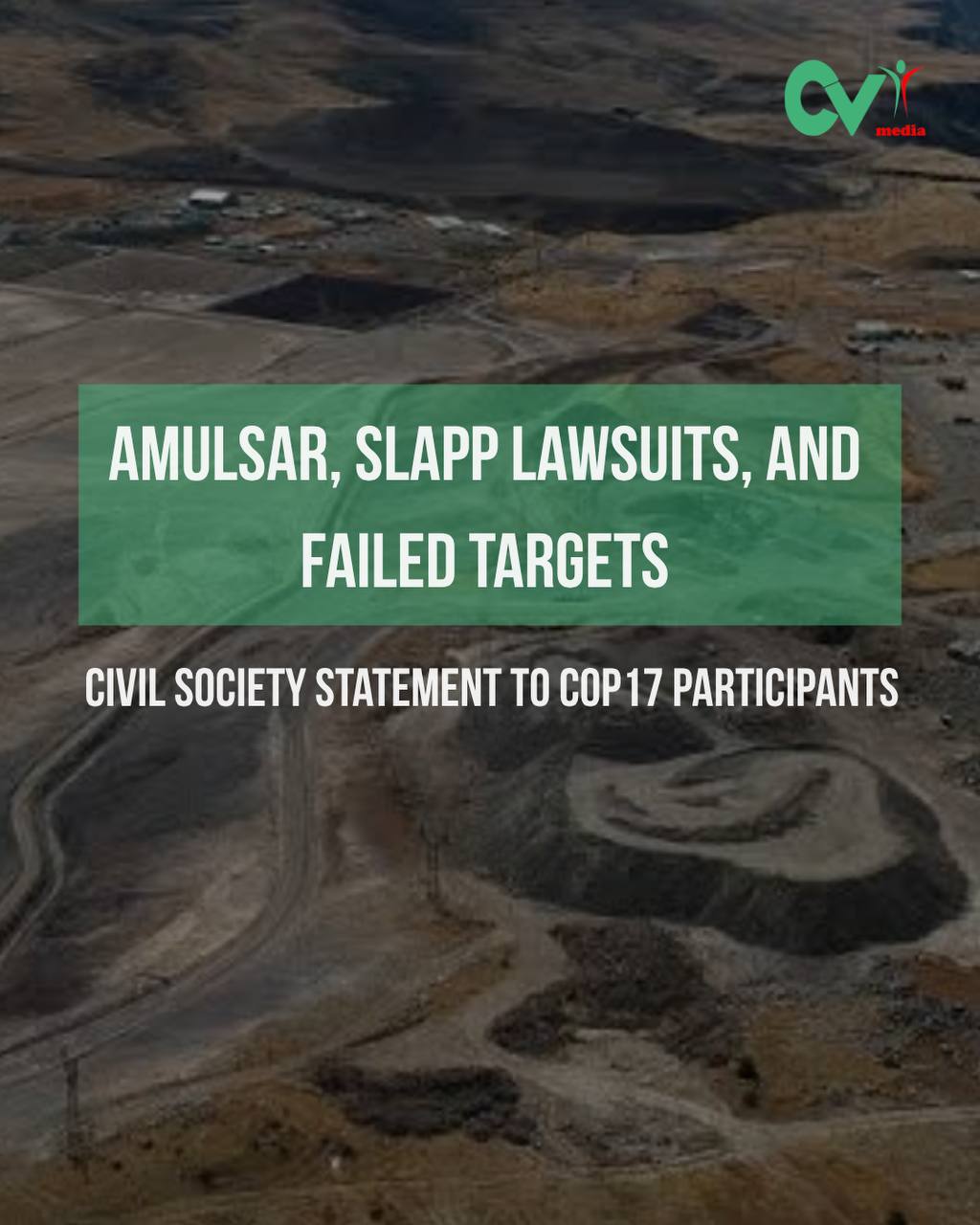
During the UN Biodiversity Conference (COP17) taking place in Yerevan, 24 Armenian environmental, human rights, and civil society organizations and initiatives issued a joint statement. They note that the Armenian government’s environmental rhetoric and global commitments on the international stage directly contradict its domestic policies.
Launch of Amulsar and Violations of International Conventions
The primary focus of the statement is the official launch of the Amulsar gold mine operations, which took place just days ahead of COP17. According to civil society representatives, the Amulsar project directly violates the UN Convention on Biological Diversity (CBD) and the Bern Convention, setting Armenia back from achieving the targets set by the Kunming-Montreal Global Biodiversity Framework (KMGBF). The mine is located in the critical water-formation basin of Vayots Dzor and Syunik provinces, posing a direct threat to the Kechut Reservoir, the Vorotan-Arpa-Sevan tunnel, Jermuk’s mineral waters, and the region’s biodiversity. The statement also references a 2025 Administrative Court ruling that declared the project’s Environmental Impact Assessment (EIA) invalid, as well as negative conclusions by international experts which, according to the authors, were ignored by state authorities.
Reasons Behind the Failure to Meet Kunming-Montreal Targets
In an accompanying briefing note, civil society representatives outlined the key factors hindering Armenia’s ability to meet the Kunming-Montreal global targets.
First and foremost, the statement highlights the prioritization of corporate interests, as legislative amendments and government decisions are frequently drafted under lobbying from the mining sector. A prime example is the permit granted to relocate Red Book-listed plant species under a "biodiversity offset" scheme.
Security crises and the aftermath of war are cited as another major obstacle. Military actions and occupation between 2020 and 2023 resulted in severe damage to the Shikahogh State Reserve, the Jermuk Hydrological Reserve, and the Sev Lich Reserve. Meanwhile, authorities often frame mining projects to the public under the guise of "ensuring national security."
The document also addresses restrictions on local self-government autonomy, pointing to decisions by the municipal councils of Jermuk, Areni, Yeghegnadzor, and Noyemberyan to ban mining activities—decisions that were subsequently challenged in court by the central government.
Strategic Lawsuits Against Public Participation (SLAPPs) targeting environmentalists and local residents are highlighted as a major barrier to public engagement and oversight.
The briefing note separately examines critical water management issues, including the impact of small hydropower plants, the overexploitation of the Ararat Valley artesian basin by commercial fish farms, declining water levels in Lake Sevan, and ongoing challenges in drinking water supply infrastructure.
Finally, the text addresses gendered impacts, noting that women in affected communities are disproportionately deprived of traditional employment in agriculture and tourism due to the expansion of mining.
Recommendations for COP17 Participants
The authors of the statement urge delegates at COP17 to bring the lack of political will and corporate pressure to the conference agenda. They also call for the removal of "biodiversity offset" mechanisms from Target 19 of the Kunming-Montreal Framework, characterizing them as tools used to legitimize illegal and destructive projects.
The full text of the letter is presented below
STATEMENT OF ARMENIAN CIVIL SOCIETY
ADDRESSED TO THE PARTICIPANTS OF THE 17TH MEETING OF THE CONFERENCE OF THE PARTIES TO THE CONVENTION ON BIOLOGICAL DIVERSITY
Yerevan, October 2026
We, representatives of Armenian civil society and environmental initiatives, activists, and citizens concerned about biodiversity conservation, welcome the holding of the 17th meeting of the Conference of the Parties to the Convention on Biological Diversity (CBD COP17) in Yerevan. However, we are dismayed because, just one week before the Meeting, the Armenian government took part in the ceremonial launching of a disastrous mining project that directly violates the United Nations Convention on Biological Diversity (CBD) and the Bern Convention on the Conservation of European Wildlife and Natural Habitats (Bern Convention), and is a setback to achieving most of the Kunming–Montreal Global Biodiversity Framework (GBF) targets. The subject matter of our dismay is the launch of a gold mine at Amulsar, financed by Ameriabank. There is extensive scientific evidence documenting its adverse impacts; local communities have fought against the project for years and have been subjected to numerous forms of reprisals. In 2025, Armenia’s Administrative Court ruled that the project’s environmental impact assessment had not been properly conducted, as a result of which some of the mining licenses lost their validity, overall making mining in the site impossible. In our view, through this act, the government is showing its citizens and the international community that it prioritizes the interests of foreign extractive businesses and investment funds over those of present and future generations in its own country, international environmental law, and its obligation to enforce it.
The high mountainous area (Amulsar Mountain) where the launch of the open-pit gold extraction project using cyanide leaching was announced is at the heart of Armenia’s water sources. Arpa and Vorotan rivers that irrigate the wine-producing province of Vayots Dzor and the agricultural province of Syunik originate from Amulsar Mountain, as does the Kechut Reservoir, built to help save Lake Sevan supplying water to the lake through the Arpa–Sevan tunnel. The area is home to rich biodiversity, including species listed in the Red Book and protected under international and domestic legislation. Finally, it is home to the village of Gndevaz, which grows and exports apricots, and the town of Jermuk, Armenia’s internationally recognized thermal spa tourism center, famous for its mineral water. As early as 2009, Armenia’s Fourth National Report submitted to the Convention on Biological Diversity identified this area as a proposed protected area. The government’s 2002 Strategy and Action Plan for Protected Areas had already established the objective of creating Jermuk National Park. Later, the area was submitted to the Bern Convention as a candidate site for the Emerald Network of Areas of Special Conservation Interest. Since 2009, however, the government has stopped reporting on Jermuk National Park to the CBD, thereby tacitly violating its own obligations to the Parties to the Convention.
Operating an open-pit mine at Amulsar sets Armenia back from achieving most of the targets of the Kunming–Montreal Global Biodiversity Framework (GBF). First, Targets 1 and 4, which call for reducing biodiversity loss and halting the loss of threatened species, are not being met. Amulsar is home to species listed in the Red Book of endangered species, newly discovered species, and rich biodiversity that requires protection. Armenia is failing to meet Target 3, which calls for protecting 30% of the country's territory and ensuring the effective management of these protected areas. First, the Armenian government halted work on the planned Jermuk National Park in the late 2000s because of the mining project. Although discussions about establishing the park have now resumed, they do not envisage including Amulsar, the mountain. Without its inclusion, biodiversity conservation planned by establishing this national park cannot be considered effective or scientifically justified. In addition, the government is planning to remove the Jermuk area, which includes Amulsar, from the European Emerald Network. Target 7, which calls for reducing pollution, is not being met. The opening of this new mine alone will result in millions of tonnes of mineral rock accumulating on the Earth's surface. Cyanide will be used in processing the ore. Acid mine drainage will emerge threatening water resources, while several tonnes of mercury, along with numerous other heavy metals, will be exposed from subsoils to the surface. This in itself contradicts the Minamata Convention on Mercury. Armenia is falling behind in achieving Target 8, which calls for reducing the impacts of climate change and water acidification. Targets 14 and 18 are also being violated simultaneously. These targets require biodiversity considerations to be integrated into decision-making and call for the removal of incentives that are harmful to biodiversity. Yet, in 2025, the Armenian government decided to provide a $150 million guarantee to the banks financing the mine. There is also a setback in achieving Target 15, which requires businesses to properly assess their risks. The environmental impact assessments (EIAs) for the Amulsar mining project and respective conclusions are seriously deficient, and the demands of the Armenian public, the Bern Convention's Standing Committee, and its Bureau to conduct a new EIA have been rejected by the government of Armenia. Target 19 calls for mobilizing funding from all sources, including private financial institutions, for biodiversity conservation. However, in the case of the Amulsar mining project, the biodiversity offset scheme proposed and financed by the lending banks, intended to “compensate” for biodiversity damage, simply enabled the legitimization of an illegal project through unrealistic promises of “compensation” and caused irreversible damage to the habitats of species listed in the Red Book. The Armenian government has also violated Target 21, which concerns access to information, by removing the independent expert report commissioned on the Amulsar mining project from government websites. Target 22 establishes public participation in decision-making. However, public participation in processes to reject the Amulsar project has been suppressed for more than a decade, while many people opposing the project have faced lawsuits designed to deter public participation, known as Strategic Lawsuits Against Public Participation (SLAPPs). Opening a mine at Amulsar will also cause a setback in achieving Target 23, which aims to ensure gender equality. In the affected communities of Gndevaz and the spa town of Jermuk, women are involved in agriculture, healthcare, and service provision — all sectors that will disappear from the area because of the mine.
It is with this kind of “performance” that Armenia will present itself to COP17, where Parties are scheduled to review implementation of the targets set out in the Kunming–Montreal Global Biodiversity Framework (GBF).
In August 2026, data published on global progress under the GBF showed that, at the current pace and with the measures being taken, the targets set for 2030 will not be achieved. We must state without hesitation that the primary reason countries fail to fulfill, or only partially fulfill, their obligations under the Convention on Biological Diversity is a lack of political will and prioritization of business interest. Other reasons include the allocation of financial resources to sectors harming biodiversity or draining the state budgets (such as military industry and servicing external debt); corporate capture of states; cuts in public spending, including severe underfunding of science and independent scientists; and the outsourcing of public functions to the private sector. As a result, the public interest in matters of global importance, and the interests of the future of human and non-human beings, are continually subordinated to short-term private interests. In this context, it is worth noting that, on the eve of COP17, a major mining forum is organized. Mining is the single most damaging sector for biodiversity. We do not believe this is a coincidence. This sector, closely intertwined with the financial industry, has the strongest lobbying power in Armenia, and it is not excluded that this lobbying will also seek to influence the COP17 deliberations.
We call on representatives of the Parties to the Convention gathered in Yerevan, not only to address country performance in meeting the GBF targets but also to straightforwardly discuss the issue of the lack of political will. We fully understand that political will is not an abstract concept. It depends on global and local political and economic systems, the degree of democracy, debt dependence, investment protection agreements and threats of corporate arbitration, inequalities between states, geopolitical blackmail, security vulnerabilities and «mining for security» foreign policies, among the many constraining factors. We urge government representatives to raise and discuss these very obstacles openly and honestly, recognizing them as the underlying reasons why biodiversity conservation is being deprioritized. We call on all other delegates who do not represent governments to keep the issue of political will, and the factors that undermine it, firmly on the conference agenda.
We also call for serious scrutiny of, and the removal from GBF Target 19 of, financing mechanisms that have caused harm instead of helping conserve biodiversity. These include biodiversity offset schemes. In Armenia, for example, the relocation of a Red Book-listed plant growing at Amulsar and its ex situ conservation at the Botanical Garden were presented as a successful biodiversity offset initiative. Similarly, at Teghut in northern Armenia, where a mine was opened in a forested area, the creation of a forest twice the size of the one destroyed was proposed as compensation, but this, too, never materialized. Nevertheless, the use of such schemes by mining companies, the banks financing them, and the government cooperating with them has artificially lent legitimacy to mining projects, despite the fact that these schemes contradict not only the letter and spirit of the CBD but also Armenia’s domestic biodiversity conservation legislation.
We wish to inform you that we have prepared a detailed briefing on the above-mentioned issues in Armenia and our local struggles to protect biodiversity. In it, we identify obstacles to achieving the GBF targets through examples of problems occurring in Armenia. This briefing is attached to the statement.
Finally, regarding criticism and demands directed by Armenian society at our own government in the context of COP17, we wish to inform you that we have launched petitions to our government related to two matters. The first calls for the halting of the illegal Amulsar mining project and conducting a new environmental impact assessment, in fulfillment of the demands of the Bern Convention’s Standing Committee and Bureau, as well as longstanding plight of Armenian citizens. The second calls for the adoption of anti-SLAPP legislation to protect environmental human rights defenders from unfounded lawsuits. The international community can also support our appeals by joining them via the following link: https://shorturl.at/ht2b9.
Signatories to the Statement
-
Armenian Environmental Front civil volunteer initiative
-
Professional Education Reforms NGO
-
New Culture of Justice NGO
-
Community Mobilization and Support Center
-
EcoLur Information NGO
-
Green Armenia Environmental Education NGO
-
Armenian Progressive Youth NGO
-
Citadel NGO
-
Women’s Resource Center NGO
-
ECO Club Youth Environmental NGO
-
Helsinki Citizens’ Assembly Vanadzor Office
-
Orbis NGO
-
Youth Impulse Youth NGO
-
CinemArt Youth NGO
-
Koriz Aygezard Youth and Community Development Center NGO
-
Healthy Environment NGO
-
Healthy Hrazdan Civil Initiative
-
Safe Corner Socio-Educational NGO
-
Successful Woman NGO
-
Spitak Helsinki Group Human Rights NGO
-
Gyumri Progress Civic Development Center
-
Direct Democracy NGO
-
+374 Political Self-Determination Club NGO
-
Nina Karapetyants
